
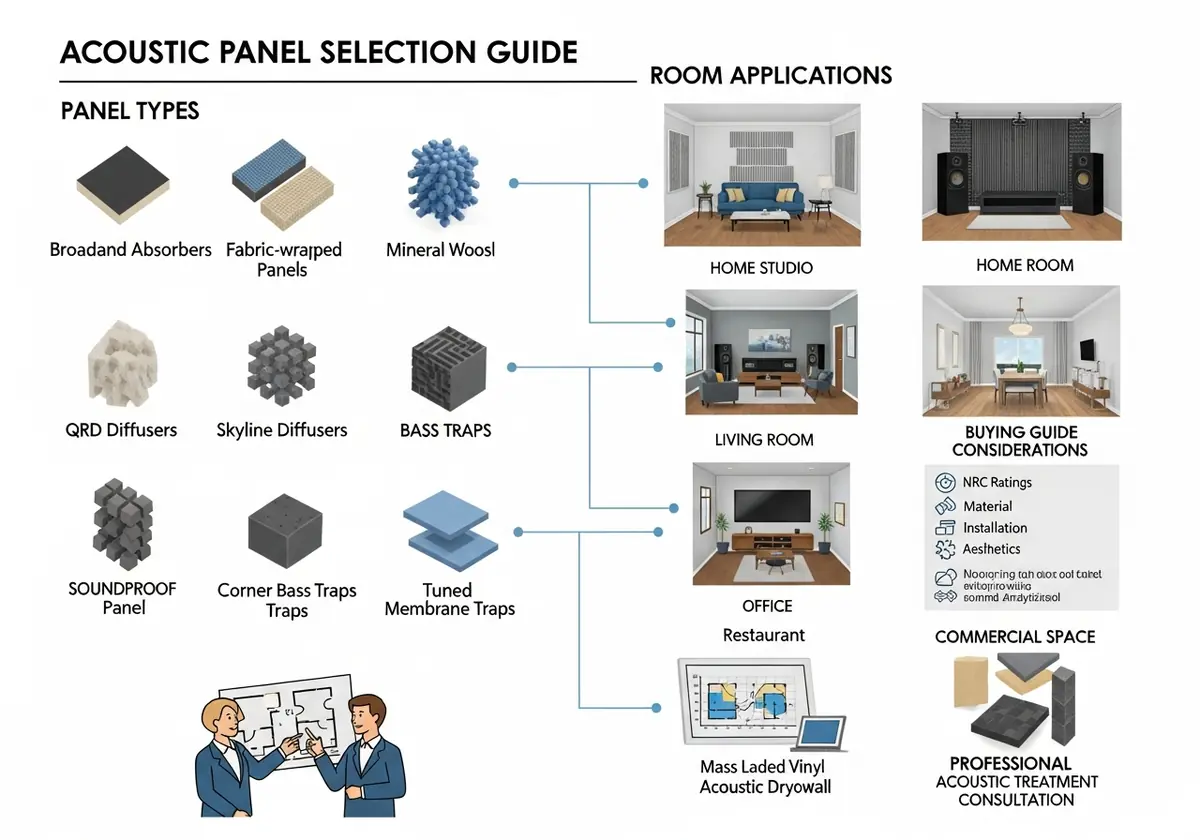
1. Understand your goal: absorption vs. soundproofing
The most important question first: are you trying to improve sound inside the room (reduce echo, reverb, flutter) or stop sound from passing through walls? These are different problems requiring different solutions.
- Acoustic absorption panels (foam, fabric-wrapped): improve sound quality inside the room.
- Soundproofing panels (MLV + mineral wool): reduce sound transmission through walls.
- Bass traps: control low-frequency buildup — critical for mixing and listening rooms.
2. What is NRC and how much do you need?
NRC (Noise Reduction Coefficient) runs from 0.0 to 1.0. An NRC of 0.85 means the panel absorbs 85% of sound energy and reflects only 15%. Higher is better. Bare concrete walls have NRC ~0.02 — essentially no absorption.
Coverage rule of thumb: treat 15–25% of total wall and ceiling surface area with acoustic panels. A 10×12 room (240 sqft floor) has roughly 600 sqft of wall/ceiling surface — treat 90–150 sqft.
| Room size | Recommended product | Target NRC |
|---|---|---|
| Small room / booth (< 100 sqft) | Foam tiles | 0.80 |
| Medium room (100-300 sqft) | Foam + fabric panels | 0.85 – 0.90 |
| Large room (300+ sqft) | Fabric panels + baffles | 0.90 – 0.95 |
| Any room with bass issues | Bass traps (all corners) | 0.95 (LF) |
3. Foam vs. fabric-wrapped: which is right for you?
Acoustic foam panels (wedge/pyramid) are cost-effective, easy to install, and work well for home studios and podcast booths. They look utilitarian — fine for a garage studio, less ideal for a home theater or office.
Fabric-wrapped panels use a rigid fiberglass core with a professional fabric face. They achieve higher NRC (up to 0.95), look premium, and are available in multiple colors. Ideal for home theaters, conference rooms, offices, and any space where appearance matters.
4. Why bass traps matter most
Low frequencies build up in room corners and cause bass that sounds different at every listening position — the #1 complaint from home studio owners. Acoustic foam does nothing below 250 Hz. Bass traps with thick rigid fiberglass (12"+ depth) control frequencies down to 40 Hz. If your room sounds muddy, add bass traps first.
5. Fire rating — why it matters
Any acoustic material installed in occupied spaces should carry at minimum a Class B fire rating per ASTM E84. Commercial spaces, shared offices, and studios open to clients typically require Class A. All our main product lines (fabric-wrapped, bass traps, ceiling baffles) are Class A. Our peel-and-stick foam tiles are Class B — appropriate for residential home use.
Not sure which panels to choose?
Send us your room dimensions and acoustics goal. We calculate the right products, quantities, and coverage for free — usually within one business day.